


Case closed.
Workers’ Compensation case managers and adjusters are often on the lookout for ways to help resolve their cases quickly and efficiently. Paragon Safety offers proven services to assist with this goal. Functional Capacity Evaluations (FCEs) assess an injured employee’s true physical capabilities, and Paragon uses the Cross-Validation FCE based on the X-RTS model, which is proven to be highly effective and legally defensible. A Work Conditioning program involves intensive daily training designed and supervised by a licensed Physical Therapist to ensure an injured employee can regain the strength and confidence to get back to work
Everyday conditioning for the everyday worker.
Work Conditioning is a daily physical training program to restore employees after an injurious incident. It also involves ergonomics coaching, education on safe work practices, and re-injury prevention and self-treatment. An individualized training program based on an employee’s specific job, Work Conditioning is an integral step in the physical and mental recovery for an injured worker. Unlike medically prescribed Physical Therapy (PT) or Occupational Therapy (OT), which are typically two or three times per week, Work Conditioning is generally done each workday for up to eight hours each day. (Note, a “Work Hardening” program typically involves more behavioral, education, and safety training, with less emphasis on the restoration of physical capabilities.)
According to NCBI, workers who are absent from work for 20 days have a 70% chance of returning, but that chance drops to 50% for those absent 45 days, and 35% for those absent more than 70 days.
Assess today’s abilities.
Functional Capacity Evaluation (FCE)
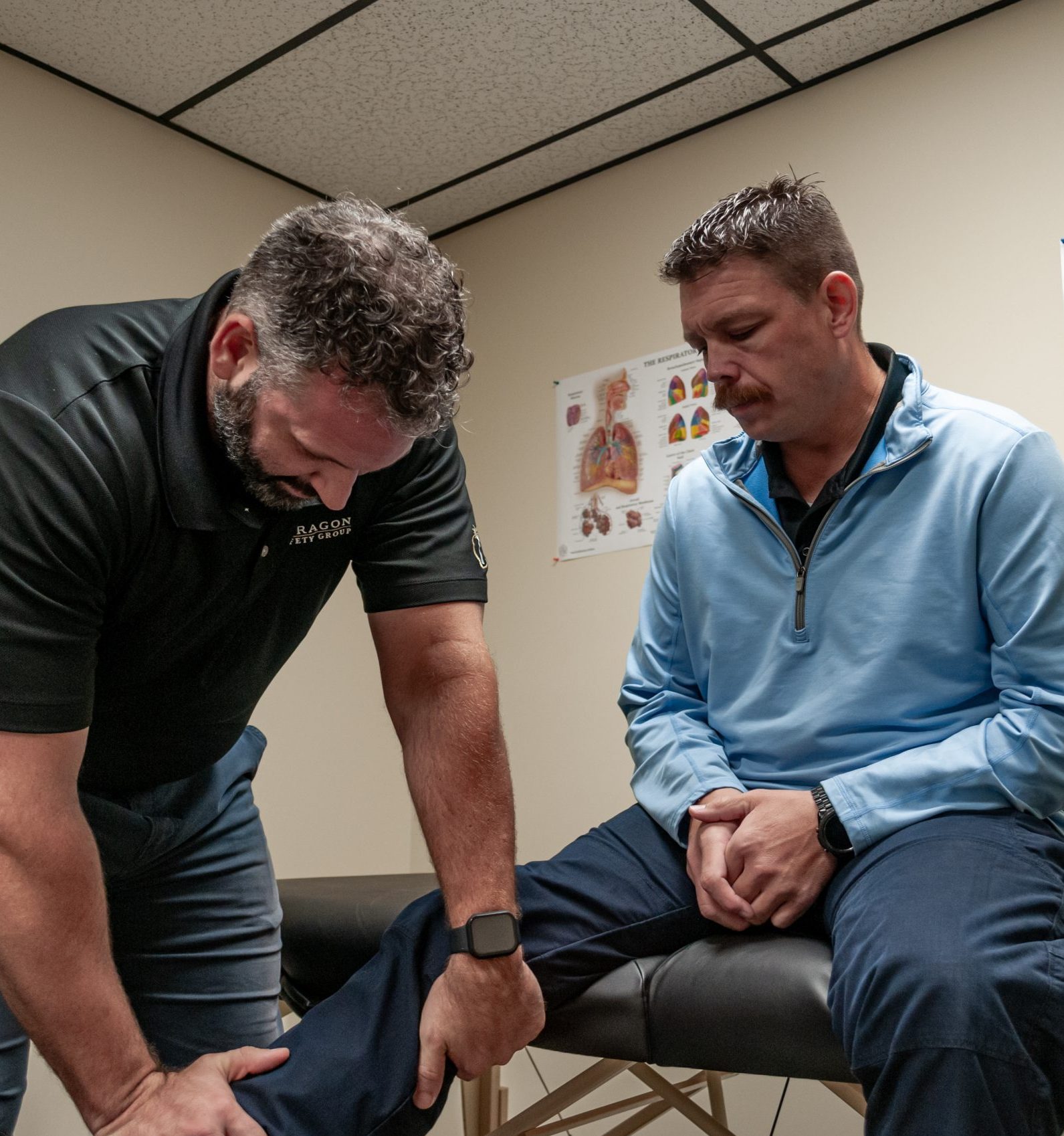
How does an employer know that an employee is physically ready to resume their role within the company? Paragon Safety offers a comprehensive Functional Capacity Evaluation (FCE) to determine a person’s physical capabilities for a specific job prior to physician’s release from care. FCEs document consistency of effort and establish recommendations for future work ability based on scientific fact—not subjective opinion.
Recent research has shown that widely-used FCE products demonstrate only 70% accuracy for consistency of effort. Paragon Safety utilizes the Cross-Validation FCE based on the X-RTS model, which is proven up to 99.5% reliable in determining consistency of effort so case managers can move forward with confidence when making next-step decisions for return-to-work cases.
The Cross-Validation FCE has proven to be more legally defensible than other FCE models. In one Ohio workers’ compensation case, for example, an injured worker was asked to pay his medical and wage reimbursement payments back to the insurance carrier when the Cross-Validation FCE results definitively showed his lack of effort in demonstrating his true physical capabilities. In contrast, individuals who have had further treatment denied when objectively giving a fully consistent effort throughout testing have proven the existence of an impairment that requires further intervention or fair compensation.
Act fast for best results.
Often, and FCE is not ordered by a physician until the patient is at or near maximum medical improvement (MMI)—but in most cases, that’s too late for an improved or return-to-work outcome. Therefore, it’s vital for a Cross-Validation FCE to be ordered as soon as a person is medically stable. Here’s why:
- To return the injured worker to transitional (or even full) duty, as early and as safely as possible.
- To identify appropriate rehab and treatment goals to promote a safe return to work.
- To identify as early as possible any roadblocks that would impede a patient’s progress and recovery, such as medical treatment plateaus, evidence of insincere effort, and/or prolonged absence from work.
- To assist the physician who may be unsure of the patient’s abilities as they relate to the physical demands of their job.
- To provide evidence of valid impairments requiring need for permanent restrictions to assist
CONTACT PARAGON SAFETY TODAY FOR MORE ON FCE.